Badminton Handbook · Chapter 9 of 16
Grips & shots
How to hold the racket, which grip to use where on the court, how to change it, and forehand/backhand and straight/cross-court shots.
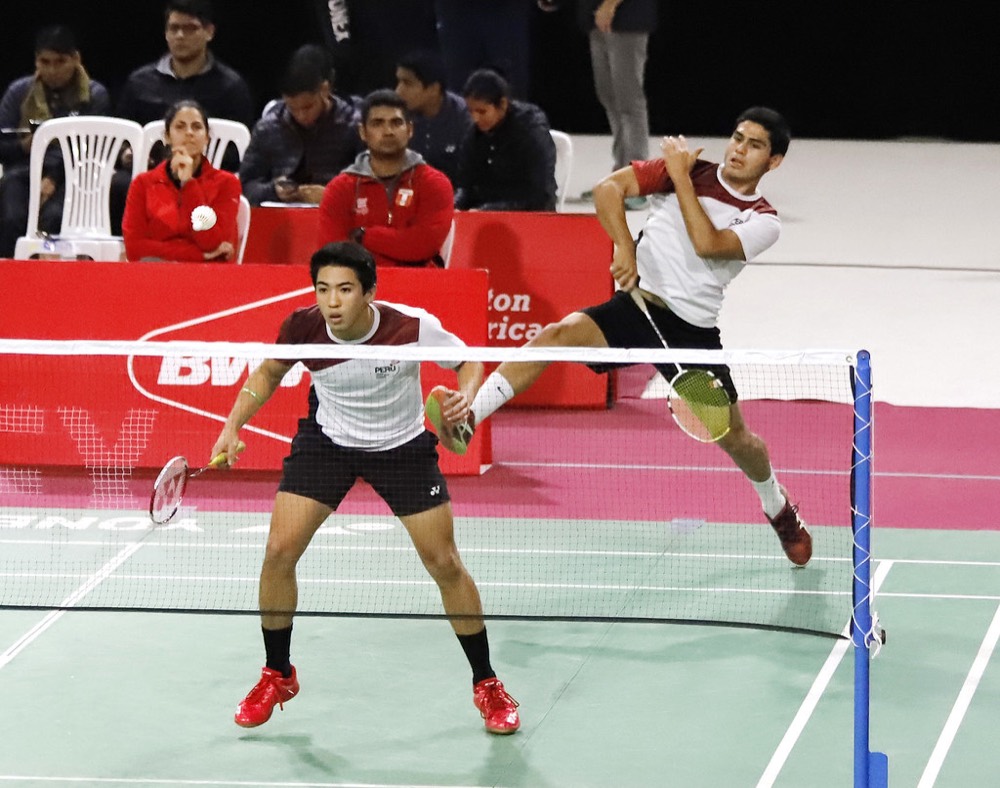
Almost every shot in badminton starts with the grip. The right grip lets the racket face point where you want with little effort, and fast, relaxed grip changes are what let good players reach the shuttle early. This chapter is written for right-handers; left-handers simply swap sides (turn on left-handed mode in Me & settings and the diagrams mirror).
Know your handle
A racket handle is not round. It has eight flat sides called bevels: two wide bevels (the flat faces that point the same way as the strings), two narrow edges (in line with the racket frame) and four corner bevels in between. You use them as landmarks for your thumb and the "V" between thumb and index finger.
The five grips
| Grip | How to hold it | Use it for |
|---|---|---|
| Forehand | Hold the racket with the frame edge-on to the floor and "shake hands" with the handle. The V between thumb and index finger sits on the top narrow edge. Index finger slightly spread, like a trigger; the handle lies in your fingers, not deep in your palm. | Forehand overheads (clear, drop, smash), forehand net shots, drives and lifts, round-the-head shots, the high serve. |
| Backhand (thumb) | From the forehand grip, turn the racket about a quarter turn anticlockwise (for right-handers) and press the pad of the thumb flat on the wide back bevel. Leave a small gap between palm and handle so the thumb can push. | Backhand net shots, lifts, drives and blocks, body defence, the low backhand serve. |
| Bevel | Like the thumb grip, but the thumb moves onto the corner bevel next to the wide bevel. This angles the face upward. | Shots from the rear backhand corner when the shuttle is behind you: backhand clears and drops. |
| Panhandle (flat) | Strings face the net, as if holding a frying pan. Very little rotation is possible, so it is fast but limited. | Kills and taps at the net tape, and some flat front-court interceptions in doubles. Avoid it for overheads. |
| Neutral (ready) | A relaxed grip halfway between forehand and thumb grip, racket up in front of you. | Waiting between shots, especially in doubles, so you can change quickly either way. |
Grip pressure and grip length
- Relaxed, then squeeze. Hold the racket at about 2–3 out of 10 while you prepare, squeeze hard for a split second at contact, then relax again. A tight grip slows your swing and tires your forearm.
- Hold longer for power. Holding near the end of the handle gives a longer lever for clears and smashes.
- Hold shorter for speed and control. Sliding your hand up the handle (choking up) shortens the lever for net play, fast drives and defence.
Which grip, where on the court
| Where you are | Typical shots | Grip |
|---|---|---|
| Front forehand | Net shot, lift, net kill | Forehand grip, held short. Panhandle only for kills right at the tape. |
| Front backhand | Backhand net shot, lift, net kill | Thumb grip, held short. |
| Midcourt forehand | Drive, push, block, smash return | Forehand grip; slightly towards panhandle for flat doubles exchanges. |
| Midcourt backhand and body | Drive, block, defence of smashes at the body | Thumb grip. The backhand covers more of your body, so many players defend with it by default. |
| Rear forehand | Clear, drop, smash | Forehand grip, held long and relaxed. |
| Rear backhand | Backhand clear or drop, or round-the-head | Bevel grip for a true backhand; forehand grip if you can get behind the shuttle and play round-the-head. |
| Serving | Low serve, flick, high serve | Thumb grip for the backhand low serve and flick; forehand grip for the high serve. |
How to change grip quickly
- Use your fingers, not your wrist. Roll the handle with thumb and index finger; the rest of the hand stays loose.
- Change early. Change during your recovery and as soon as you read the shot, never at the moment of contact.
- Return to neutral. After every shot, relax back to the neutral grip with the racket up.
- Practise it on its own. Turn grip changes into a habit with the Grip-change ladder, then add them to shadow footwork.
Common grip mistakes
- Panhandle on overheads. It blocks forearm rotation, so clears fall short and the shoulder works too hard.
- Squeezing all the time. It costs speed and can lead to a sore elbow or forearm.
- Thumb wrapped round the handle on the backhand. Put the thumb flat on the bevel, or there is nothing to push with.
- Never changing grip. One "do-everything" grip makes backhands and net shots awkward. See why your backhand feels weak.
Forehand and backhand shots
A forehand is any shot played on your racket side with the palm facing the shuttle; a backhand is played on the non-racket side with the back of the hand leading. In the rear backhand corner you have a third option, round-the-head: you move behind the shuttle and play it like a forehand over your non-racket shoulder. It is stronger but costs more movement (see round-the-head or backhand?).
Straight and cross-court
Every shot can be hit straight (down the line, parallel to the side lines) or cross-court (diagonally to the other side).
- Straight is the safe default. It travels the shortest distance, reaches the opponent fastest and keeps them in the same corner. Your recovery is shorter too.
- Cross-court moves the opponent the most, but it travels further and passes through the middle of the court. That gives them more time and often lands on their stronger side. A cross-court net shot can travel several times further than a straight one.
- Choose cross-court when the opponent is committed to one side or late recovering, and keep it tight (close to the net, or close to the side line).
- Direct the shuttle with contact point and racket face, not just the arm. For a forehand cross-court, take the shuttle a little further in front and turn the face across; for a straight shot, hit beside or just in front of you with the face square to the side line. On the backhand side it is the reverse: an earlier contact goes cross-court, a later one goes straight.
- Keep the same preparation for both so the opponent cannot read the direction (see disguise).
Shot directory: straight vs cross-court
| Shot | Straight | Cross-court | Tip |
|---|---|---|---|
| Clear / backhand clear | Pushes the opponent to the same rear corner | Longest flight; needs extra height to avoid interception | Cross-court clears from defence must be high and deep |
| Drop / backhand drop | Short, quick, hard to reach early | Drags the opponent diagonally forward | Use cross-court drops when the opponent is leaning back |
| Smash / cross-court smash | Fastest to the floor; the most common choice | Angled away from the defender | In doubles, a straight smash keeps your partner's coverage simple |
| Net shot / backhand net shot | Tight to the tape, safest | Very effective if the opponent is slow forward, but easy to intercept if high | Only go cross-court when your shot can stay low over the net |
| Lift / backhand lift | Safe, gets you time to recover | Makes the opponent turn and run diagonally back | A cross-court lift must reach the back line |
| Drive / backhand drive | Flat and fast down the line | Flat across into the gap between doubles players | Keep drives flat and below the opponent's racket height |
| Block / cross-court block | Soft return of a smash to the net in front of you | Soft return to the far net corner | The cross-court block is a classic way to move a smasher forward |
Every shot above has its own page with steps, common faults and a video in Shots & strokes.
It's free. If it helped your game, you can support it.