Badminton Handbook · Chapter 7 of 16
The science of badminton
Why the shuttle flies the way it does, smash physics, biomechanics and match physiology.
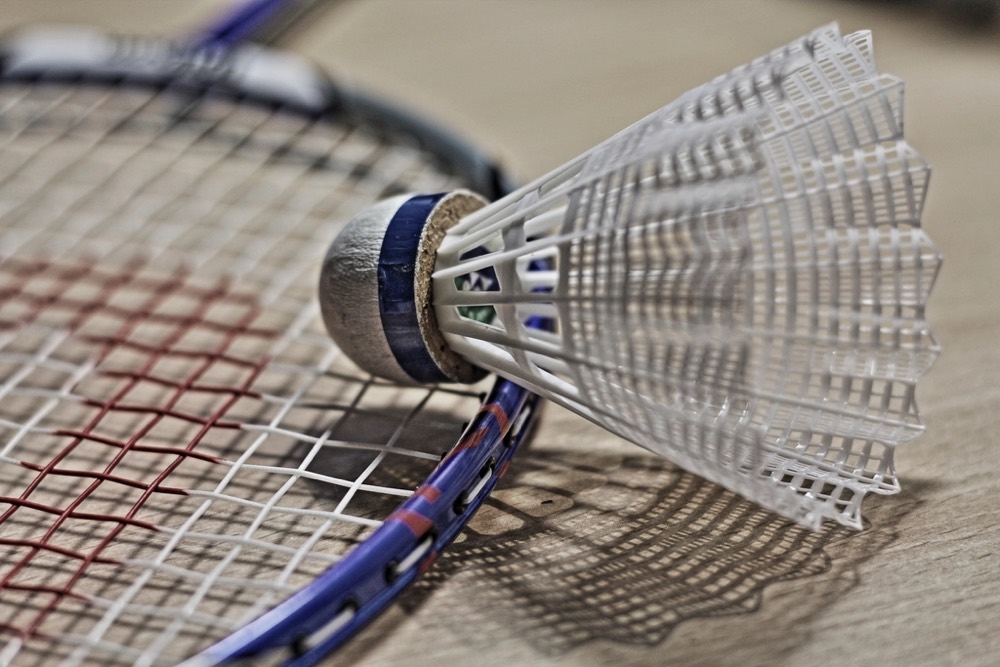
1. The shuttle: a projectile built to slow down
A shuttle is very light (about 5 g) with a large feather skirt. That combination creates very high air drag. A smash may leave the racket at several hundred km/h, but the shuttle loses speed dramatically within metres. Physicists who studied it (Cohen et al., New Journal of Physics, 2015) describe a "pure drag" flight. Instead of a symmetric arc like a ball, the shuttle travels almost straight, then curves down and falls nearly vertically. They also describe an "aerodynamic wall": beyond a certain launch speed, hitting harder barely makes the shuttle go further, because drag dominates.
The falling speed (terminal velocity) of a feather shuttle is only about 6–7 m/s, which is why a high clear drops almost straight down at the back of the court.
2. Why it always flips cork-first
The heavy cork sits in front of the light, drag-producing skirt, like the weight and fins of a dart. When the racket hits the cork, the shuttle briefly flies feathers-first, then flips over within a few centimetres and stabilises cork-first. The feathers also make it spin slightly, which helps the flight stay stable. This is why tumbling net shots, which slice the cork, are so awkward to return: they hit the opponent's racket before the shuttle has re-stabilised.
3. How fast is a smash?
- Guinness World Records: 565 km/h by Satwiksairaj Rankireddy (India, April 2023), faster than a Formula 1 car's top speed.
- Fastest female hit: 438 km/h by Tan Pearly (Malaysia, 2023).
- Because of drag, the shuttle arrives at the defender far slower than it left the racket. Defenders still have only a fraction of a second, which is why a low, ready stance and short, compact blocks work best.
4. Biomechanics: where the power comes from
Power is generated through a kinetic chain: legs push, then hips and trunk rotate, then the shoulder, then the elbow and forearm. Each segment speeds up the next. Research on elite smashes shows that upper-arm internal rotation and forearm pronation (turning the forearm) contribute much of the final racket-head speed. The famous "wrist snap" is largely forearm rotation. A relaxed grip that squeezes only at contact lets these segments move freely. See forearm rotation and rotational throws in the library.
5. The physiology of a match
- Intermittent, high-intensity: studies of elite singles report rallies averaging well under 15 seconds with similar or longer rests between them, repeated for 40–90 minutes. It is many short sprints, not one long one.
- Heart rate stays high throughout. A solid aerobic base lets you recover between rallies; anaerobic power fuels each explosive rally.
- Hundreds of direction changes, lunges and jumps per match put big demands on the calves, Achilles tendons, knees and hips. That is why the strength section of this app focuses on lunges, calves and landings.
- Reaction and anticipation: top players read the opponent's body and racket before contact, and use the split step to be ready to push off in any direction.
Science summaries are simplified for general readers.
It's free. If it helped your game, you can support it.